Lowrance and BioBase informing Manatee Conservation in Lake Ossa, Cameroon Africa

Fascinating study recently published in the esteemed scientific journal Ecology and Evolution demonstrating how Lowrance HDS and BioBase were used to create the first bathymetric and vegetation map of Lake Ossa in Cameroon, Africa. These maps along with other environmental data collected by researchers were used to create a habitat suitability model for the charismatic African Manatee, whose populations are now threatened in Africa due to habitat degradation.

This is an open access journal from Wiley and available here for download.

Below is the abstract

African manatee (Trichechus senegalensis) habitat suitability at Lake Ossa, Cameroon, using trophic state models and predictions of submerged aquatic vegetation

First published: 07 October 2021

Abstract

The present study aims at investigating the past and current trophic status of Lake Ossa and evaluating its potential impact on African manatee health. Lake Ossa is known as a refuge for the threatened African manatees in Cameroon. Little information exists on the water quality and health of the ecosystem as reflected by its chemical and biological characteristics. Aquatic biotic and abiotic parameters including water clarity, nitrogen, phosphorous, and chlorophyll concentrations were measured monthly during four months at each of 18 water sampling stations evenly distributed across the lake. These parameters were then compared with historical values obtained from the literature to examine the dynamic trophic state of Lake Ossa. Results indicate that Lake Ossa’s trophic state parameters doubled in only three decades (from 1985 to 2016), moving from a mesotrophic to a eutrophic state. The decreasing nutrient gradient moving from the mouth of the lake (in the south) to the north indicates that the flow of the adjacent Sanaga River is the primary source of nutrient input. Further analysis suggests that the poor transparency of the lake is not associated with chlorophyll concentrations but rather with the suspended sediments brought-in by the Sanaga River. Consequently, our model demonstrated that despite nutrient enrichment, less than 5% of the lake bottom surface sustained submerged aquatic vegetation. Thus, shoreline emergent vegetation is the primary food available for the local manatee population. During the dry season, water recedes drastically and disconnects from the dominant shoreline emergent vegetation, decreasing accessibility for manatees. The current study revealed major environmental concerns (eutrophication and sedimentation) that may negatively impact habitat quality for manatees. The information from the results will be key for the development of the management plan of the lake and its manatee population. Efficient land use and water management across the entire watershed may be necessary to mitigate such issues.

Lake Ossa Bathymetric Map
First ever bathymetric map of Lake Ossa in Cameroon created with Lowrance HDS and BioBase. Lake map can be viewed in genesismaps.com/socialmap.

BioBase EcoSound Vegetation and Bottom Hardness Algorithms Improved

Sonar technology continues to improve bringing anglers and aquatic managers better, more clear pictures of the underwater environment on which they are so intently focused. Launched in 2011, BioBase’s EcoSound technology was the first cloud aquatic mapping system designed to process sonar logs from off-the-shelf Lowrance® sonar and create maps of bathymetry, aquatic vegetation biovolume, and bottom hardness for aquatic resource professionals. Today, BioBase is the leading cloud software solution for automated lake and coastal seagrass mapping.

Between 2011 and 2014, the algorithm underwent five major revisions. The bottom hardness algorithm has undergone two major revisions, with the last one in 2014.  Thus, our code base was due for an overhaul in order to maintain performance and compatibility with newer generation Lowrance and Simrad sonar. This refactoring effort was also an opportunity for us to improve the vegetation and bottom hardness algorithms. Many of these improvements also carry over sister consumer technology C-MAP Genesis, which uses many of the same algorithms and backend processing architecture

Continue reading “BioBase EcoSound Vegetation and Bottom Hardness Algorithms Improved”

BioBase Feature Alert: Export Depth Contour Shapefiles

BioBase’s primary strength is its power as an automated processing engine delivering high quality geospatial data layers on aquatic habitats with very little user input outside of the physical effort to drive a boat and passively log sonar over an area of interest. In addition to the online analysis tools within BioBase like the polygon tool and automated statistical reports, users can export raw depth, vegetation, and bottom hardness data along their track, in X,Y,Z grid format, Google Earth imagery, Lowrance or Simrad Charts, AND NOW ESRI SHAPEFILES OF DEPTH CONTOURS! This feature has been in high demand for survey companies and governments who require detailed water volume analysis for aquatic habitat and fisheries management. Below we walk you through some helpful tips about the feature and how to use it.

Go To Tools – Export Data and click “Depth Shapefiles”

Example from a big lake:

D_Areas are polygon areas of each contour interval. Depending on your needs, you can calculate water volume by depth with the area of these “disks” or dissolve them to create a custom colored depth chart. D_Contours are contour polylines. NOTE: shapefile exports do not come with a projection and are in the WGS 84 global coordinate system (CRS 4326). If your GIS system doesn’t like you and says it can’t draw because there is no projection, select WGS84.

Example from a small pond:

GolfCoursePondBioBase
5.8 acre (24,281 sq. m) pond as viewed in BioBase
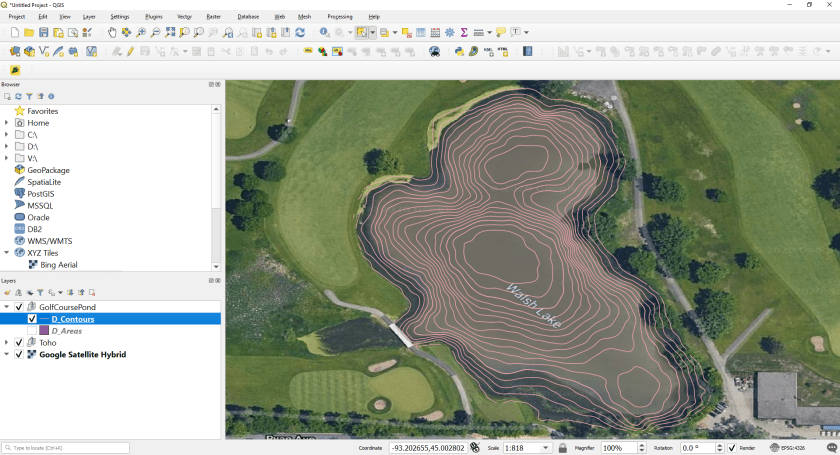
GolfCoursePondQGIS
Exported 1ft contours. The user can control whether contours are in imperial or metric, but the values are always stored in metric (e.g., for the 1ft contour, the VALUE field in the attribute table will show 0.3048). For metric contours, they come out in 0.25m intervals
GolfCoursePondDepthPolys
Depth Areas as polygons are also bundled into the zipped export. This will allow the user to carry out detailed water volume analysis as a function of depth with fewer post-processing steps than were originally required when data was only exportable as points. The VALUE field in the Attribute table is the Contour value in meters and VALUE2 is the outer range or deeper contour value of the Depth Area polygon.

BioBase continues its mission to deliver water and fisheries resource professionals high value data products in the hopes that you can focus less of your efforts on making maps and more on the important tasks of research and conservation.

Export BioBase EcoSound Maps as Lowrance Charts

2020 has been a busy year for BioBase improvements and new feature releases. Previously exclusive to BioBase’s sister consumer mapping platform, C-MAP Genesis, BioBase users can now export their bathymetric, aquatic vegetation heatmap, or bottom hardness map in a file format (AT5) that is compatible with most newer generation Lowrance and Simrad chartplotters. This feature enables researchers and aquatic resource managers to return to surveyed areas of interest and precisely target follow-up surveys or management actions (e.g., strategic taking of water or aquatic plant samples, placement of fish habitat structures or aeration equipment, precision applications of aquatic herbicides, etc.)

SideBySideVegMaps

In the images and captions below, we’ll walk you through how to do this in your biobasemaps.com account.

  1. Register your Lowrance or Simrad Chartplotter in your BioBase Account
PlotterScreenshot
Assuming you have already recorded your sonar data and successfully uploaded to biobasemaps.com, log into your BioBase account. Click “Plotters”
AddDevice
Add unique details of your chartplotter. This feature is compatible with most newer (newer than 2014) Lowrance and Simrad GPS capable devices (e.g., Lowrance HDS, Elite Ti and Ti2, Simrad GO and Evo)
LowranceSystemAbout
Look in the “About” menu of your Chartplotter. Image above is from a Lowrance HDS Carbon.
SerialContentID
Look for the Serial Number and Content ID alphanumeric code. Enter these into the plotter form on biobasemaps.com

2. Export the GPS Chart file from the desired EcoSound Trip or Merge from BioBase.

ExportAT5
In the Export Data tool, select “GPS Chart Generation”
GPSChartGenerationModal
Export the desired layers

3. Unzip the downloaded file and save to a MicroSD card (<32 GB).

7-ZipAT5
The layer will export as .zip with a random GUID name. The zip file must be unzipped (7-Zip is a great freeware for unzipping files) and the entire contents of the extracted zip file should be copied to a MicroSD card. The contents in the folder are propriety, encrypted files (.AT5) that are specific to the device you registered in your account. The chart file will not work in other non-registered devices. You can register multiple devices. One card can hold multiple AT5 folders (charts) and recorded sonar logs. Cards cannot be larger than 32 GB however.

4. View and Use in your Lowrance or Simrad!

JosephineHeatMap
Insert the card with the saved AT5 chart files. Go to the Chart and select the appropriate Chart Source in Chart Options. Voilà!
JosephineCompositionAT5
Sample bottom hardness map from the same BioBase survey.
ChartCategories
If you want to view a blue- (or custom-) shaded contour map, simply uncheck the Vegetation/Composition categories in one of the Chart menus.
Screenshot_2020-05-18_14.11.44
Detailed, custom-made bathymetric chart. Note that prior to using for navigation, close attention by the user should be given to the quality of the sonar data recorded and resulting accuracy of the map.


New BioBase Feature Alert: Google Earth Imagery Exports

At C-MAP, we are excited to announce the release of a new feature that allows users to export exact replicates of their BioBase EcoSound maps as Google Earth images (.kmz and .kml; Figure 1). This YouTube video will walk you through how it’s done.

GoogleEarthBioBaseCoverImage
Figure 1. Image of seagrass cover in Newport Bay, CA USA mapped with Lowrance, processed with BioBase EcoSound and exported as a Google Earth .kmz file. Example can be found in the free demo account on http://www.biobasemaps.com.

BioBase processed raw sonar logs and creates habitat maps with sophisticated algorithms. The outputs you see in BioBase are tiled georectified images (.png) of the outputs. The Google Earth feature converts the .png images to Google Earth’s .kml and .kmz file format.  .kml downloads are smaller and reference the images on BioBase servers. .kmz downloads are larger and are exact copies of the images stored on our servers. The .kmz option is best for users who wish to archive local copies of their BioBase maps.

These images allow BioBase users to share spatial files with their stakeholders in a free Google format with which many are familiar and use regularly.  Recipients can interact with the output zooming in and out to their desire and also adding custom logos and waypoints as they wish (Figure 2).

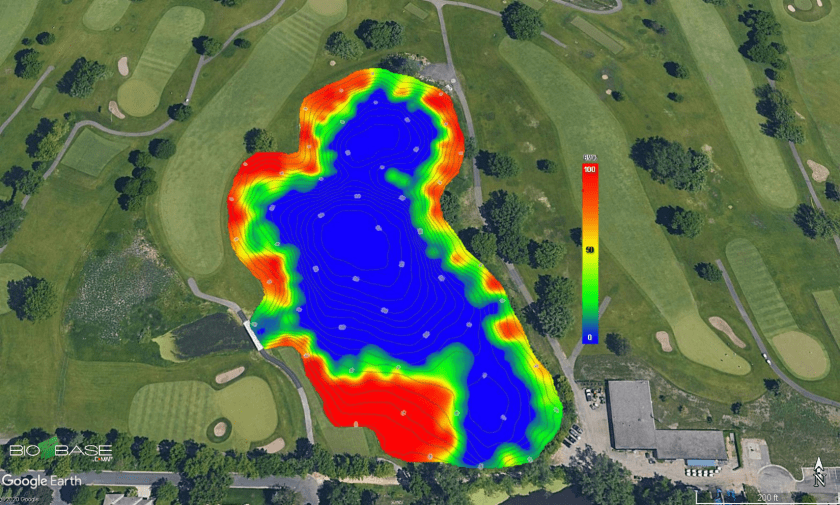
GolfCoursePondBioBaseGoogleExport
Figure 2. Add your own logos and other information to the Google Earth exported BioBase EcoSound image

Further, there are a range of open source tools that will convert .kml and .kmz to GIS files for use in ESRI and QGIS products.  Given the popularity and widespread use of .kml and .kmz files, there are a range of other applications that we are eager to hear about. Please feel free to share in the comments below.

Converting EcoSound .kml/.kmz files to ESRI Layers (.lyr)

Special thank you to Kevin Johnson and Jennifer Moran at FL Fish and Wildlife Conservation Commission for sharing a tutorial about how to convert .kml/.kmz files to ESRI Layer (.lyr) files for analysis and overlays in ESRI GIS products:

  1. Open ArcMap
  2. Open ArcToolbox > Conversion Tools > From KML > KML to Layer

ESRI Toolbox image

      • Input KML File
        • Toggle to saved .KML file Lake_Kerr_Biobase.kml (example) > Open
      • Output Location
        • Default output location is Documents\ArcGIS > Click the folder icon on right and toggle to appropriate folder
      • Output Data Name (Optional)
        • Will typically show the name of the kml, change if preferred
      • Select Checkbox for Include Ground Overlay (optional)
        • Only necessary for Raster data. Not necessary for lines/points/polygons

KML to Layer Dialog

*This will take some time to process/load and will show up in ArcCatalog as “FileName.lyr”. Processing will depend on the file and image size. After it displays in the catalog, drag and drop or select Add Data to display the layer on the map.

**Arc GIS may shut down/disappear. You may not receive a green checkmark for execution completion. Reopen the program and go into your Catalog. Should not need to reconvert from .kml.

Lake_Kerr18_BioBase
Lake Kerr (FL USA) aquatic vegetation heat map as seen in BioBase
Lake_Kerr18_GoogleEarth
Lake Kerr (FL USA) aquatic vegetation heat map as seen in Google Earth
Lake_Kerr18_ArcGis
Lake Kerr (FL USA) aquatic vegetation heat map converted to a .lyr file in ArcGIS

BioBase: tips and lessons learned

In the 8+ years BioBase has been in service, we’ve seen our share of sonar logs and maps (both good and bad).  We’ve learned some things and improved back-end processes that have resulted in you getting better maps processed faster. But we’ve also learned from you, our users, about strategies and techniques that result in better outcomes, and what to avoid.  Here are eight of those lessons learned:

1. Good transducer installation is critical

You could be the most experienced hydrographer in the world and execute the perfect survey design, but your map will be mostly worthless if your transducer is not securely attached to your boat or is slanted at an angle. We’ve devoted a fair amount to this topic in previous blogs, so we won’t dwell on it here. The two key take aways are: 1) ensure the transducer is installed straight in all directions keeping in mind the slant of the hull in the water fully loaded.  Replicate that tilt with your tongue jack when installing your transducer. 2) Install the transducer where the flow of water is smooth and laminar over the transducer face at all speeds. If you lose your transducer signal as the boat speeds up, you probably have an issue with cavitation (water turbulence) around the transducer face. Adjust the transducer height (sometimes only a very small amount) or move it away from rivets or anything else near the hull that could cause cavitation. One of the benefits of working with consumer devices like Lowrance and Simrad is that there is a wealth of online self-help resources and service centers that can help you install your transducer correctly.  A simple Google Search “Lowrance Transducer Installation” will turn up all the resources you need.  This one from Lowrance is one of our favorites.  If you have multiple survey boats and want to make your unit portable, I strongly recommend purchasing and installing multiple transducers on all of your boats rather than a portable transducer bracket.  In the grand scheme of things, consumer-sonar transducers are cheap and the consistent results you will get from a firmly mounted transducer is worth it!

5fadb-fig1_ducer_angle
Figure 1. Example of a slanted transducer and what affect it has on BioBase maps.  A simple Google Search of “transducer installation” will turn up many very good self help resources about how to properly install your transducer.

Continue reading “BioBase: tips and lessons learned”

Determining dredging needs in lakes, ponds, and Arizona’s aqueduct system!

By Ray Valley

Aquatic Biologist and BioBase Product Expert

One of BioBase’s strengths is its simplicity. You don’t need an advanced engineering degree in hydrography to make a high quality bathymetric map with an off-the-shelf sonar device. If you have your transducer installed correctly, settings correct on your Lowrance, and achieve good coverage on your waterbody of interest, then BioBase’s EcoSound algorithm will produce a very precise, high quality bathymetric map output within minutes of upload to biobasemaps.com. The speed and ease of bathymetric mapping wins the day for many of our users, but perhaps even more valuable, is the benchmark you are setting for an unknown day in the future when something has changed on the lake and you need to have some “historical” information to understand how much change has taken place

Use Case: Monitoring Sedimentation

One of our most frequently asked questions by new users is “will BioBase measure sediment thickness or the depth of the sludge?” This was a source of a recent blog. Interestingly, the answer is different depending on how long our customers have been using BioBase. For the user who has no prior information about how deep the lake or pond is supposed to be, BioBase may not provide detailed enough information about the actual thickness of the sediment (sediment depth is correlated with EcoSound hardness but it is highly variable; see this blog for further details).  However, for the pond management consultant who happened to “BioBase” a client’s pond in 2013 while she happened to be on site for another matter and is now hearing from the client in 2022 that his pond is “filling in,” the answer about whether BioBase can tell him how much sediment has filled in is a most definite yes! For this pond consultant, it was a most fortuitous (or perhaps prudent?) thing that she decided to voluntarily map her clients pond in 2013.  Now with a 2022 survey, she can precisely quantify exactly how much sediment has accumulated and where over the 7 years by doing a simple subtraction of the depth and water volume between surveys and comparing maps.  The comparison of maps can be done a fancy GIS way like described in this blog. Or a quick and easy way through BioBase (see examples below).

Continue reading “Determining dredging needs in lakes, ponds, and Arizona’s aqueduct system!”

Mapping Hidden Channels with Genesis Live

River channel thalwegs (the line of lowest elevation within a valley or watercourse) are often dynamic, and sometimes hidden features of large river systems.  Especially low slope or impounded systems.  The thalweg is a critical geomorphological feature of river and reservoir systems and affects everything from sediment transport, to fisheries habitat, to algae or invasive plant control.

Thus a good bathymetric contour map is a necessary pre-requisite for effective river and reservoir management.  Here, we walk you through how to use new real time technologies (C-MAP’s Genesis Live) to produce smooth, precise, and accurate maps of hidden river thalwegs all within one trip to the site and with automated post-processing with BioBase’s EcoSound.  We’ll use an annotated image gallery to take you through this process.

Continue reading “Mapping Hidden Channels with Genesis Live”

Utilization of a Web-Based Mapping Interface to Enhance Inland Fisheries Management Strategies in Texas

A. Adams, M. De Jesus, G. Cummings, and M. Farooqi

Texas Parks and Wildlife Department, Inland Fisheries


Abstract:

Texas Parks and Wildlife Department Inland Fisheries (TPWD IF) biologists traditionally use “stand-alone” mapping interfaces to generate 2-dimensional (2-D) aerial outputs of fish habitat and benthic surveys of aquatic systems. Preliminary work has shown promise in the use of a different method, which generates interactive 3-dimensional (3-D) high-definition (HD) outputs. During field surveys, a Lowrance© Elite 9Ti GPS unit with TotalScan™ transducer was used to generate data points along boat transects on waterbodies of interest. A waterbody “Vegetation Analysis Report” and HD maps were then generated from these data using web-based mapping algorithms through BioBase©, and ArcMap 10.3© GIS software. Aquatic vegetation biovolume, bathymetric mapping, and benthic substrate composition outputs, produced by BioBase© aided biologists in selecting best management strategies, regarding aquatic vegetation management and angler access development at three central Texas impoundments. This tool can prove valuable to fisheries managers needing a higher resolution of survey results to fine-tune management strategies. At a cost of $2,5001 US for a yearlong subscription, cost-benefit would have to be assessed by individual users, based on their needs.

Continue reading “Utilization of a Web-Based Mapping Interface to Enhance Inland Fisheries Management Strategies in Texas”

Consumer Sonar for Bottom Mapping: Updated Reference List

Another FAQ we get is wondering if there are published studies using BioBase technology? There are many legacy applications on which the BioBase technology is based. Further, now that a sufficient passage of years has accumulated to support the research to publication cycle, we’re happy to share several BioBase-specific studies published in the peer-reviewed literature.  We also cite some other key papers highlighting the use of consumer sonar technology for scientific research. This is far from an exhaustive list, especially with the growing body of references focusing on mapping with consumer side-scan. If there are good published papers you know of that are not on this list, please share in the comments.

Continue reading “Consumer Sonar for Bottom Mapping: Updated Reference List”

Translate »