Analysis of Alternative Mapping Methods

Budgets are tight, time is short, labor resources and technical know-how are scarce.  These truths are the motivating force behind the ciBioBase system.  Recently, we ran an analysis that demonstrates the cost-effectiveness of ciBioBase.  We selected 3 peer-reviewed studies that demonstrated three alternative methods for whole lake assessments of vegetation abundance and compared the costs of producing a vegetation biovolume map with ciBioBase.  The first two studies Valley and Drake (2007) and Sabol et al. (2009) used a scientific-grade echosounder, associated software, and required expertise in hydroacoustics and Geographic Information Systems (GIS).  Hardware and software costs were adjusted to 2012 dollars which actually brought costs down to a total of $18,400.  These costs were amortized over 5 years at 5% interest and scaled to daily costs assuming use in a season would not typically exceed 45 days.  For both methods, hardware and software costs amounted to approximately $84 a day.  We did not factor in time on the water for any of these analyses, or the cost of training in hydroacoustics, geostatistics, and GIS.

Labor costs were relatively large in the Valley and Drake (2007) study because the authors were working in environments that exceeded the capability of the vegetation-detecting algorithm they were using.  Specifically, noisy signals generated in surface-growing vegetation canopies were thrown out and thus biasing biovolume (i.e., percent of the water column occupied by vegetation) downward.  Consequently,  Valley and Drake did ping-by-ping verification and reclassification where signals were obscured by surface-growing vegetation.  Summing the modest hardware and high labor costs to manually verify thousands of pings, the cost of producing a vegetation map in a 500-acre lake using methods described in Valley and Drake (2007) was approximately $1,288.

Labor costs were significantly lower in the Sabol et al. (2009) investigation because we assume vegetation did not grow to the surface in the Wisconsin study lake during the investigation and thus the vegetation algorithm processed individual files relatively quickly.  Taking the labor costs (10 hrs @ $25/hr) in Sabol et al. (2009) and adding in adjusted amortized hardware and annual maintenance costs, the costs of producing a map on a 500-acre lake was a much lower $357 compared with Valley and Drake (2007).
The third study evaluated the LAKEWATCH volunteer lake monitoring program administered by the University of Florida.  LAKEWATCH utilizes commercial-grade Lowrance sonar units to log data on bathymetry and vegetation height/biovolume (otherwise known as percent volume inhabited; Hoyer 2009).  Entry-level technicians analyze 100 random points from pooled transect files and record depth and estimate plant height to get a lake-wide estimate of percent area covered by vegetation and percent volume inhabited with aquatic plants.  Although the objective of LAKEWATCH is not to create high resolution vegetation maps, in order to make apples-to-apples comparisons, we had to scale-up the Hoyer (2009) method to reflect the same survey resolution (16,383 points) of the previous two methods.  This resulted in an incredibly high cost of $6,884 to produce the same type of vegetation map as described with the previous two methods.
ciBioBase 
Because we automate the analysis and mapping of vegetation, there is very little labor outside of conducting the survey, save for a recommended hour of reviewing the data after a trip and verifying the output.  Also, the hardware and software costs are minimal because we analyze data from Lowrance HDS-line sonar systems that are coupled with differentially corrected GPS systems and retail for $700-$2200.  Running the same calculations as the other methods, we estimated the per survey day cost of mapping a 500-acre lake was a very low $125; 2.8 times cheaper than the next lowest described by Sabol et al. (2009).

Daily Costs
Method Amortized Hardware Maint-enance Labor Subscription Cost Total      Cost
Valley and Drake (2007) $84 $23 $1,181  NA  $1,288
Sabol et al. (2009) $84 $23 $250  NA  $357
Hoyer (2009)* $3 $0 $6,881  NA  $6,884
ciBioBase $3 $0 $25 $97 $125
*High resolution vegetationmapping was not an objective of Hoyer (2009) and thus the following scaled-up cost estimates should be viewed as a hypothetical scenario for an equal comparison to other methods

The low rate of ciBioBase doesn’t consider any of the value-added features of ciBioBase such as:

·       Automation: No training needed in hydroacoustics, geostatistics, or GIS.  Our cloud-based software analyzes patterns in the acoustic signal and uses standard geostatistical techniques to produce accurate maps.
·       Centralization: As data from more systems is uploaded, algorithm performance is continually verified and enhanced.  These enhancements are constantly refined in the cloud and are pushed universally to all users, free of charge.

·       Crowd-sourcing: Multiple subscribers from an organization can contribute their data to an optional shared repository.  Organization members can leverage each other’s efforts and data to produce a single output.

·       Speed: Lowrance sonar units occupy little space on board (and actually are portable!) and come with a skimmer transducer that allows data collection of up to speeds of 10 mph.  As such a 500-acre lake may take half the time to traverse 25 mi of transect compared with methods 1 and 2.

·       Efficiency: Because there’s no “set-up and break down” with our method, hitting “record” is the extent of the effort you need to do to start logging data.  While doing so, you can be collecting other important fisheries, aquatic plant, or water quality data on the lake.
·       Data Visualization and Verification: We offer visual, geospatial tools to replay your trip and verify the automated output.

Log in and see for yourself! Go here and type demo@cibiobase.com for the login email and for the password enter “demo.”  You’ll first need Microsoft Silverlight, click here to check to see if you already have it installed on your PC or Mac or need to download it.
Literature Cited
Hoyer, M.V. 2009. Calculations for successful planning. Lakeline Spring 2009: 39-42.

Sabol, B.M., Kannenberg, J., and Skogerboe, J.G. 2009. Integrating acoustic mapping into
              operational aquatic plant management : a case study in Wisconsin. Journal of Aquatic Plant
              Management 44-52.

Valley, R.D. and M.T. Drake 2007. What does resilience of a clear-water state in lakes mean for the spatial heterogeneity of submersed macrophyte biovolume? Aquatic Botany 87: 307-319.

Polygon Feature Tutorial – Updated

The polygon tool is one of BioBase’s strongest features. The ability to calculate total water body, vegetation cover percentage, surface acreage, and more is crucial to environmental management. Reduce the amount of herbicide you need to apply by taking the guess work out of treatments. Pinpoint locations of beneficial vegetation plantings and monitor the success using the vegetation biovolume value created by the polygon tool. The polygon tool is one of the most versatile features and a use can be found in any area of interest. Below is a step by step walkthrough of how to use the polygon tool.

A few things to take into consideration when creating a polygon. First, polygon tool is a very data intensive feature and requires a lot of processing power. In order to limit the demand on server, we must limit simultaneous polygon requests system wide to two. After clicking save and the polygon tool begins the calculations you should see the following statement in the upper right hand corner “Generating statistics: please be patient. Response times depend on waterbody size and amount of data.”. You will also see a spinning circle indicating the tool is working this may take up to 3 minutes depending on the data and the polygon. If you receive a prompt to try again at a later time, the servers may be busy processing other polygons. Try waiting a few minutes then trying again.

Step 1. Select the “Polygon” tab

Select the Polygon Tab

Step 2. Click create polygon button
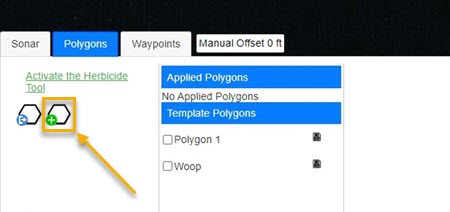
Click create polygon button

Step 3. Name the polygon

Name the polygon (required)

Step 4. Add a description to the polygon

Add a description to the polygon

Step 5. Draw the polygon by clicking points, double click to end the drawing

Draw the polygon by clicking points, double click to end the drawing

Step 6. Save the polygon

Save the polygon

Step 7. Data Table

Example of data table generated by the polygon tool

  The polygon management tool allows subscribers to create a polygon within their data for automated processing and assessment of specific boundaries within an upload.  After you gather Lowrance sonar data and upload it to your BioBase account to create a bathymetric, vegetation and hardness maps, you can determine water volumes, acres, max and average depths, vegetation average biovolume percentage, vegetation cover percentage and more.

More information on the polygon tool can be found on our support resources page –Support Resources Operators Guide

The days of estimating water volumes are over.  Even though we were already providing detailed water volume analysis of the area covered, BioBase will now allow you to create and manage your treatment zones and areas of concern in greater detail.  BioBase is taking lake management and habitat analysis to the next level and automating everything you need to take your collected data full circle. For more information on Navico’s sustainability initiative click Here

Verification of ciBioBase Depth Output

At Contour Innovations we are our own skeptics and constantly perform verification investigations of BioBase output for accuracy. 

As Chief Aquatic Biologist, I’ve been comparing bottom depths sampled with a survey rod with its corresponding depth derived from the automated depth outputs from the BioBase System.  In the figure below depths from Elk Lake (Clearwater Co. MN) are color coded from 1 – 50 ft with blue becoming more intense as depth increases.  The circles are depths recorded with a survey rod while the squares are ciBioBase depths.  Below is one visual representation of the high agreement between true depths and BioBase depths. This visual shows the symbol color agreement demonstrating accuracy in the output! 

True depth data come courtesy of Minnesota Dept. Natural Resources Fisheries Research Biologist Donna Dustin and are copyright of Minnesota DNR.

Ray Valley Joins Contour Innovations as Aquatic Biologist

Please join Contour Innovations in welcoming Ray Valley (RayV@ContourInnovations.com) to our team as Chief Aquatic Biologist. 

Previously employed by the Minnesota Department of Natural Resources as a Senior Research Biologist in the Section of Fisheries, Ray developed aquatic plant mapping protocols with acoustic technology and GIS, researched the link between aquatic plants and fish populations, and most recently chaired the successful launch of a collaborative and comprehensive long-term lake monitoring program called Sustaining Lakes in a Changing Environment (SLICE), Ray holds a B.S. degree in Fisheries from the University of Minnesota and a M.S. degree in Fisheries Ecology from Michigan State.

Ray brings a wide range of expertise to our team specifically related to aquatic vegetation mapping, GIS, and fisheries.   Our team is excited to have his deep technical background in aquatic habitat mapping using acoustics.  “We’ve only scratched the surface of what our platform can do both as a direct output and the benefit our users receive from a collaborative and uniform mapping effort,” said Matt Johnson, CEO of Contour Innovations.  “We will continue to add resources to ensure that Contour Innovations continues to push the boundaries in automated temporal and spatial mapping and Ray brings the expertise to go to the next level.”

Ray will be responsible for aquatic research using the ciBioBase System and providing technical mapping and research support for our empowered customers.    He will also be a keystone piece in designing and evaluating new features and valuable tools provided by the BioBase automated mapping system.  Ray will use his expertise to develop SOPs for and design mapping protocols for our customers’ unique mapping needs and to help maximize time on the water.
Ray has published the following selected list of articles related to submerged aquatic plant mapping and links to fish:

  • Valley, R.D. 2000. Effects of macrophyte structural heterogeneity and fish prey availability on age-0 largemouth bass foraging and growth. M.S. Thesis. Michigan State University, East Lansing.
  • Valley, R.D. and M.T. Bremigan. 2002.  Effects of macrophyte bed architecture on largemouth bass foraging: implications of exotic macrophyte invasions. Transactions of the American Fisheries Society 131(2):234-244
  • Valley, R.D. and M.T. Bremigan. 2002. Effects of selective removal of Eurasian watermilfoil on age-0 largemouth bass piscivory and growth in southern Michigan lakes. Journal of Aquatic Plant Management 40(2):79-87.
  • Valley, R.D., T.K. Cross, and P. Radomski 2004. The role of submersed aquatic vegetation as habitat for fish in Minnesota lakes, including the implications of non-native plant invasions and their management.  MN DNR, Division of Fish and Wildlife, Special Publication No. 160.
  • Valley, R.D., M.T. Drake, and C.S. Anderson. 2005. Evaluation of alternative interpolation techniques for the mapping of remotely-sensed submersed vegetation abundance. Aquatic Botany 81:13-25.
  • Valley, R.D., and M.T. Drake. 2005. Accuracy and precision of hydroacoustic estimates of aquatic vegetation and the repeatability of whole-lake surveys: field tests with a commercial echosounder. MN DNR, Division of Fisheries and Wildlife, Investigational Report No. 527.
  • Valley, R.D., W. Crowell, C. Welling, N. Proux. 2006. Effects of low dose applications of fluridone on submersed aquatic vegetation in a eutrophic Minnesota lake dominated by Eurasian watermilfoil and coontail. Journal of Aquatic Plant Management 44:19-25.
  • Valley, R.D. and M.T. Drake. 2007. What does resilience of a clear-water state in lakes mean for the spatial heterogeneity of macrophyte biovolume? Aquatic Botany 87:307-319.
  • Valley, R.D., M.D. Habrat, E. D. Dibble, and M.T. Drake. 2010. Movement patterns and habitat use of three declining littoral fish species in a north-temperate mesotrophic lake. Hydrobiologia 644:385-399.
  •  Beck, M.W., L. Hatch, B. Vondracek, and R.D. Valley. 2010. Development of a macrophyte-based index of biotic integrity for Minnesota lakes. Ecological Indicators 5:968-979.
  • Heiskary, S and Valley, R.D. In press. Curly-leaf pondweed and interrelationships with water quality. MN DNR Division of Fish and Wildlife, Investigational Report No. 557.
  • Valley, R.D. and Heiskary, S. In preparation. Short-term declines in curly-leaf pondweed across a network of sentinel lakes in Minnesota: potential influences of snow depth and water temperature. To be submitted to Lake and Reservoir Management.

Ray’s most research interests include lake ecology with specific emphasis on the interaction between aquatic plants and water quality regimes. 

He can be contacted at RayV@ContourInnovations.com

New Z-offset (depth offset) Feature

Some of our customers have requested the ability to make their maps even more accurate by eliminating the distance between their transducer and the bottom.  We listened! 
Depth calculations (z) using hydro acoustics are calculated from the source (transducer) to the bottom. Because a depth finder transducer is typically mounted below the water surface, depth readings are always off by the distance between the bottom of the transducer and the surface of the water . . . not anymore!   With the new z-offset feature, any user can now recalculate depths by entering this distance and reprocessing the trip.  For example, if your transducer is 6 inches below the surface, all of your depth readings should have a half foot added to them.  A 10 foot z should actually be 10.5” deep.  With a .5” z-offset, all of your depths will be reprocessed for better accuracy.  This is very important when calculating water volumes! 
The z-offset feature can also be used for calculations to high water marks or draw downs.  By using the z-offset for a 5 foot draw down scenario, our users can identify which bottom structures will be exposed as land (see below).  In addition, lake and pond managers can determine total water volumes at a high water mark by measuring this distance.  By simply offsetting all depth readings with a single z-coordinate offset, your trip will be reprocessed the way you want it.  Water volumes, blue scale, and plant biovolume will all be recalculated in your account.  Simple!
Below is an example of the z-offset in action for a simulated draw down.  We took an accurate trip from Trout Lake in Wisconsin and offest the z-coordinate by 20 feet to simulate a 20 foot draw down.  The new blue scale reflects the changes and displays the new land in green:

Auto Blue Scale Bathymetry Mapping

Contour Innovations (CI) is announcing the addition of a new feature of our BioBase System.  As many of you know, each trip uploaded to your account is processed for depths and plant canopy heights to automatically create maps and output the layered data in your interactive online account.  From now on, depth contours will be displayed in blue scale after launch of our new blue scale image feature.  When loading your vegetation layer, blue scale will disappear but transparent contour lines will display beneath the % biovolume output. 
This feature is great for lake and pond managers that are interested in getting a quick assessment of any sized water body to understand where the deep spots are for diffuser placement and overall management.  We still employ a TIN anlysis for accurately estimating total water volume.  On a pay per upload plan, our customers can get this data quickly for as little as $100 per water body and in as short as 10 minutes.   You collect the data with your low cost Lowrance HDS depth finder, upload it to a secure account from your computer, and the raw sonar is processed in the cloud in minutes.  Images of the blue scale can be exported with ease to be included in management plans (images in this blog are direct exports from the BioBase System).  State agencies are using the System for bathymetric output to update their existing lake maps provided to anglers.    This is just another great feature added to the powerful BioBase System.
To further demonstrate the power of automation and centralization anyone that has already uploaded trips to the BioBase System can now get blue bathymetry for those uploads with little effort.  To try it out, log into your account and click the interactive viewer for any trip.  Using the REPROCESS tab, check “contours” and resend the trip to our servers.  Within minutes you will get an email letting you know that your reprocess has been completed and blue scale will be provided for this trip.  Using an online account there are no software updates or manual processing of older trips.  Let our servers do the work.  That’s what they’re there for.  Anytime we add a new feature to BioBase, anything you’ve already uploaded to your account can be updated.   It’s pretty cool stuff!

Please contact us with any questions at matt@ContourInnovations.com or 715.864.9347.  Pond managers can contact our exclusive partner, Aquatic Eco-Systems (Orlando, FL) at mattr@aquaticeco.com or 407.462.4697.  Let us know what you think!

Translate »