Paradise Lake Improvement Board (MI)

Contour Innovations has recently adapted the ciBioBase platform and pricing options to support the mapping initiatives of local government units, home owner associations, and improvement boards.  One of the most recent additions to this project has been the Paradise Improvement Board in Carp Lake, MI (Lower Peninsula) and we’re excited about it!*

The Paradise Lake Improvement Board (paradiselakeimprovementboard.com), through crowd sourcing and citizen science concepts, can now quickly determine the location and abundance of aquatic vegetation for management interventions and quantitative evaluation of the effectiveness of those techniques.   

There’s no technical expertise required!  Our biologists walked the volunteers of the PLIB through a demo account to demonstrate the key features for success with ciBioBase and discuss the recommended settings and collection techniques.    

 
 It’s this simple

Led by board member Catherine Freebairn, the PLIB purchased 2 Lowrance™ HDS units that will be set up as portable units for the lake group and an unlimited upload subscription to ciBioBase.com.  These units will be used to map Paradise Lake during dedicated mapping time as well as during pleasure cruises with passive collection.  With each minute on the water, the PLIB volunteers will be collecting vital statistics on aquatic vegetation, bathymetry, water temps, water volumes, and water clarity, all by hitting “log sonar” on their new HDS sonar units.  All of this data will be stored in their private online account. 
Aquatic biologist Ray Valley commented, “Protecting our lakes demands understanding of what lies beneath the surface and how its changing as a result of environmental changes and our responses to them.”
Using the innovative ciBioBase System, the PLIB has started building a historical database of their aquatic environment to monitor vegetation abundance and other important water quality characteristics over time.   They can now quickly determine the location and abundance of submerged aquatic vegetation for management interventions and quantitative evaluations of effectiveness of those techniques.  This database is the catalyst for efficient management today and in the future.  By gathering  this data each time someone is on the lake, the Board can crowd source the mapping effort and share information with their service providers for collaborative and objective decision making.  

“The PLIB has always shown a substantial passion for their lake and we feel that their early adoption of our powerful technology will be rewarded on many fronts,” said Contour Innovations’ CEO Matt Johnson.  “It’s very easy to work with groups like the PLIB who see the big picture in lake management and monitoring and want to see results.  They develop close relationships with their service providers and home owners to work hand-in-hand in understanding the best opportunities to reach their goals.  This is the first time that groups like this can use acoustics for accurate vegetation mapping and ciBioBase fits perfectly within their strategy,” he added.  

The PLIB will be working with their service providers (who will also have access to uploads and maps) to make important management decisions, monitor changes, and objectively evaluate if management interventions are having their desired effects.  With the support of all involved, including Contour Innovations’ own aquatic biologists, the future looks bright for Paradise Lake and anyone that enjoys all it has to offer!
 An Example of a Lake Mapped with ciBioBase
 Aquatic Vegetation Displayed in % BV (water column occupied by plants)

If you’re interested in finding out more about ciBioBase and how it can help your association or improvement district, please contact us and we’d be happy to set up a person demo for you with one of our biologists.  Please contact Jesse Amo for additional details:  JesseA@ContuourInnovations.com

For more information on the Paradise Lake Improvement Board please check out their website at paradiselakeimprovementboard.com.

*Contour Innovations does not release personal information about our customers.  We obtained permission from the PLIB before this media release.

Precision Management-Time to Quantify

Lake Harriet Monitoring Before and After Harvester. . .

A multitude of factors impact the health of aquatic systems creating a need to monitor lakes’ “vital signs”.  In the same way it is expected that a medical doctor will do more than glance at a patient and say: “you look fine” the same is needed for our lakes.  A number of different vital signs are necessary to give a precise assessment of human health and our aquatic systems are no different, they are complex biological systems.  ciBioBase provides many “unchecked” parameters that have not been assessed until now in an automated processing system.  Two trips on a small section of Lake Harriet in Minneapolis collecting “vital signs data” have already told a story about big changes in the aquatic community.  What more can we learn about this complex ecosystem by simply monitoring with ciBioBase on an ongoing basis?
A data collection trip with ciBioBase in late June on Lake Harriet revealed what you might expect from an unseasonably warm spring in a lake infested with Eurasian watermilfoil(EWM).  Aquatic plant growth was several weeks ahead of schedule with EWM dominating the sample area on north shore and already being matted on the surface.  The majority of near-shore areas sampled exhibited near 100 % EWM biovolume (% water column occupied).  In fact, in the far east and west reaches of the sample area our survey-boat was skirting matted EWM too dense to navigate through.  Wherever vegetation occurred (percent area coverage) on the June 18th survey the biovolume average was very high, due to it being composed primarily of EWM (average of 54.4%).  
BEFORE:
 

In late August a comparison trip was completed, navigating the same transect line from the June trip using ciBioBase following the Lowrance HDS track overlay on the unit.  A striking feature noticed shortly after getting on the water was…..Where was all the topped-out vegetation?  The transect sampled on June 18th skirted topped-out EWM, but on August 22nd no topped-out vegetation occurred in the same sampling area.  This excerpt from the Star Tribune written by Bill McAuliffe on June 10th explains: “The Minneapolis Park Board’s milfoil harvest began with a single mower.  . The harvesting each year generally requires at least two passes through each lake. Cedar Lake was scheduled for mowing Friday. After that, Lake Harriet is on the schedule.” (View the article by clicking here).  That would explain the drop in average biovolume in vegetated areas from 54.4% to 16% and overall average biovolume for the entire sampled area from 28.3 to 5.1%.

AFTER:
*Automated Reports Generated for Each Trip Uploaded to ciBioBase

ciBioBase not only displays that the average biovolume in vegetated areas for this study site dropped from 54.4% to 16% and overall average biovolume for the entire sampled area from 28.3 to 5.1%, but it also outlines vegetation distribution.  Spatial characteristics such as the shift from about 30% of the sampled area having a biovolume of  >80% to 0.34% of the sampled area having a biovolume >80% after the EWM harvest are also a part of the ciBioBase data output.

ciBioBase has enabled users to precisely compare changes in biovolume and spatial distribution of vegetation; pinpointing changes and quantifying their outputs.  This means precision monitoring and management using quantifiable target goals while leveraging objective “before and after” monitoring data that is easily collected, processed, and viewed with the ciBioBase system.

Knowing precisely “where and how much” are critical components to knowing if management plans are effective.  Another excerpt from Bill McAuliffe’s Star Tribune article states: “The Lake Minnetonka Conservation District launched its two mowers Thursday, about on schedule because it uses school teachers to run them, said Judd Harper, who manages the district’s milfoil removal. But weed growth on the lake is “a lot worse than it was last year,” Harper said.”  ciBioBase provides numbers behind “a lot worse”.

Using the ciBioBase system and historical database comparison, it is now possible to quantitatively identify year to year and other temporal trends.  Managers can now implement corresponding management based on sound scientific data and quantitative metrics.  ciBioBase is the key to precision management!

TRIP COMPARE FEATURE IN CIBIOBASE

* %BV (% of the water column filled with plants)
ANOTHER SHOT OF BAIT FISH PICKED UP BY STRUCTURE SCAN


ABOUT CIBIOBASE:

ciBioBase removes the time and labor required to create aquatic maps! The System was engineered to provide automated cloud based bathymetric and aquatic vegetation mapping and historical trend tools for aquatic habitat analysis. ciBioBase leverages log file formats recorded to SD cards using today’s Lowrance™ brand depth finders and chart plotters. Data you collect while on the water is uploaded to an online account where it is processed by our servers automatically! We rely on automation to make vegetation mapping cost effective by reducing the technical skills, staff, and hours to produce vegetation abundance maps from raw sonar collection. With the human element gone, you get accurate and objective mapping at lightening speeds! The result is a uniform and objective output all over the world!

What to do with all this Lake Habitat Data!?

Fifteen data points per second, four hours on Lake X today, several more tomorrow.  Lake Y and Z to follow.  Repeat next year and the year after.  Since no one has to process the data, it can be collected during non-dedicated mapping time by hitting record on your Lowrance HDS each time  your on the water.  Simple math tells you that this is going to lead to A LOT of data.  What are you going to do with it all?

This “problem” is new to biologists and lake management practitioners in the 21st Century.  Decision making in a data “poor” environment has been much more common and indeed is still a real problem.  The “problem” of too much data, really isn’t a problem at all.  Modern computing technology can return only information that is important to you and archive the rest for safe keeping.

With regards to aquatic plant assessment and monitoring in lakes, never before have we been able to rapidly collect and interpret information about how much plants are growing and where.   So, we spend three hours going back and forth on our favorite 230 acre, upload our data to ciBioBase and get a pretty map and some statistics on the density of the vegetation (Figure 1).  So what?  What does it mean?

Figure 1.Example automated summary report from ciBioBase.

Well, admittedly it is difficult to judge whether 78% of the lake being covered with vegetation (PAC) is normal.  What is normal?  This exemplifies the importance of collecting baseline information to judge whether changes from time A or B are significant.

The invasive aquatic plant, Eurasian watermilfoil has a tendency to grow to the surface of lakes, displace native plant species, and impede navigation.  The extent of surface growth and overall cover of Eurasian watermilfoil and other invasive plant species are typically the conditions that lake managers and citizens want to reduce.  ciBioBase provides a rapid and objective way to monitor how cover and surface growth of vegetation is changing as the lake is affected by various stressors and our responses to them (e.g., herbicide treatments).  For instance, often a water resource agency or citizen group will state objectives in a lake management plan something to the effect of “Objective 1: reduce the abundance of Eurasian watermilfoil by 80%.”  What should be asked next is 80% of what? What is our yardstick?  We can’t expect to be successful at water and fisheries resource conservation without clearly defining management targets and evaluating whether we’re getting there.

Furthermore, there is a tight link between water quality and aquatic plant growth.  Clear lakes with all native plant species often have high cover of vegetation, but relatively little surface-growing vegetation (except near shore or in shallow bays).  As more nutrients run into the lake from lawns and parking lots, aquatic plants initially increase in abundance and grow closer to the surface to get sunlight from the clouding water.  If we continue to mow our lawns down to the lake edge, over fertilize, and route water from parking lots and roofs into our lakes unabated, then aquatic plants crash because the water is too turbid to support plant growth.  Next thing you know, largemouth bass, bluegill, and northern pike disappear and you find your lake on the EPA’s Impaired Water’s List and now you need to spend million’s to clean it up.  ciBioBase can be used to prevent you from getting to that point.

One precise way of doing so is to monitor the maximum depth that vegetation grows in your lake.  There is a tight link between water clarity and the depth that plants grow in lakes (Figure 2).  The extent of plant growth integrates the short-term dynamic nature of water clarity and gives a measure of the overall water clarity conditions for the year.  The conventional water clarity monitoring routine involves citizens and lake managers taking a dozen trips a season to the middle of the lake to drop a Secchi disk down and measure the distance where the disk disappears from sight.  With one 3-hr mid-summer ciBioBase survey, you can get a measure of water clarity conditions for the entire season.  This depth should remain relatively consistent from year to year in stable watershed and lake conditions.  A change of two feet over the course of a couple of years should raise a flag that conditions in the lake may be changing and initiate some initial investigation into possible causes.


Figure 2. Relationship between the maximum depth of vegetation growth as a function of water clarity from 33 Minnesota lakes where lakes were mapped with sonar and water clarity data was collected with a Secchi disk.

To bring this discussion full circle, we should ask: how do we know the change in point A or B is due to a real change in lake conditions and not an artifact of our sampling?  This question plagued the 20th Century Lake Manager to the point of gridlock.  In the 21st century, we can overwhelm the question with data to get almost a census of the current conditions rather than a small statistical sample fraught with error.  Lake Managers don’t have to physically wade through all this data to find the answer.  High-powered computers and processing algorithms can do the heavy lifting, the lake manager or concerned citizen can focus on implementing practices that will result in clean water and healthy lake habitats.

Polygon Feature Tutorial – Updated

The polygon tool is one of BioBase’s strongest features. The ability to calculate total water body, vegetation cover percentage, surface acreage, and more is crucial to environmental management. Reduce the amount of herbicide you need to apply by taking the guess work out of treatments. Pinpoint locations of beneficial vegetation plantings and monitor the success using the vegetation biovolume value created by the polygon tool. The polygon tool is one of the most versatile features and a use can be found in any area of interest. Below is a step by step walkthrough of how to use the polygon tool.

A few things to take into consideration when creating a polygon. First, polygon tool is a very data intensive feature and requires a lot of processing power. In order to limit the demand on server, we must limit simultaneous polygon requests system wide to two. After clicking save and the polygon tool begins the calculations you should see the following statement in the upper right hand corner “Generating statistics: please be patient. Response times depend on waterbody size and amount of data.”. You will also see a spinning circle indicating the tool is working this may take up to 3 minutes depending on the data and the polygon. If you receive a prompt to try again at a later time, the servers may be busy processing other polygons. Try waiting a few minutes then trying again.

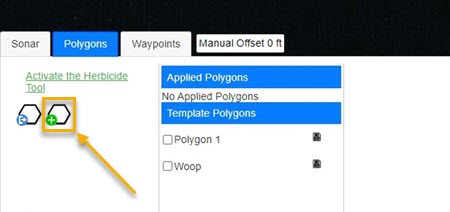
Step 1. Select the “Polygon” tab

Select the Polygon Tab

Step 2. Click create polygon button

Click create polygon button

Step 3. Name the polygon

Name the polygon (required)

Step 4. Add a description to the polygon

Add a description to the polygon

Step 5. Draw the polygon by clicking points, double click to end the drawing

Draw the polygon by clicking points, double click to end the drawing

Step 6. Save the polygon

Save the polygon

Step 7. Data Table

Example of data table generated by the polygon tool

  The polygon management tool allows subscribers to create a polygon within their data for automated processing and assessment of specific boundaries within an upload.  After you gather Lowrance sonar data and upload it to your BioBase account to create a bathymetric, vegetation and hardness maps, you can determine water volumes, acres, max and average depths, vegetation average biovolume percentage, vegetation cover percentage and more.

More information on the polygon tool can be found on our support resources page –Support Resources Operators Guide

The days of estimating water volumes are over.  Even though we were already providing detailed water volume analysis of the area covered, BioBase will now allow you to create and manage your treatment zones and areas of concern in greater detail.  BioBase is taking lake management and habitat analysis to the next level and automating everything you need to take your collected data full circle. For more information on Navico’s sustainability initiative click Here

Translate »